
Recent data across oncology practices points to a clear trend: patients who engage with educational materials about their therapy tend to stay on treatment longer than those who don’t.
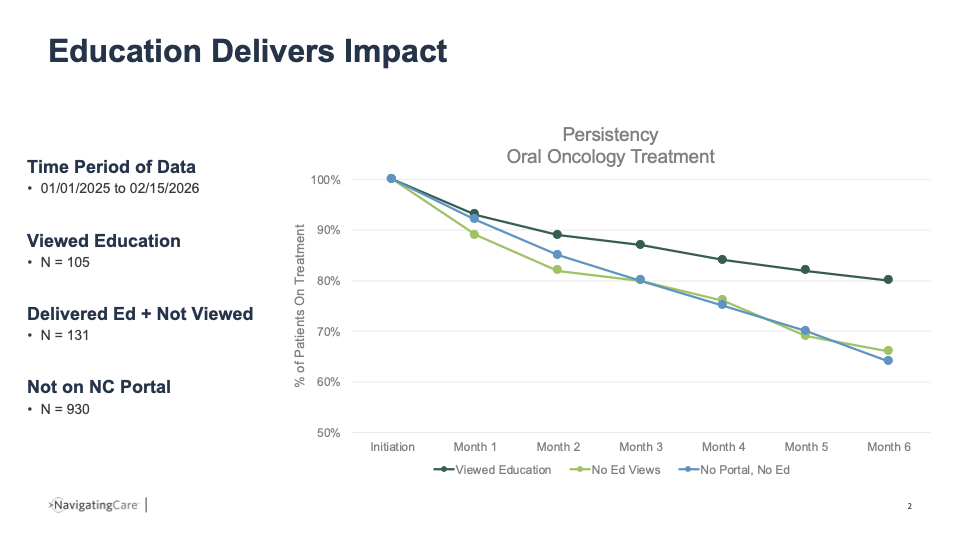
While many factors influence treatment persistence, this pattern stands out. Over a six-month period, patients who viewed assigned education about their oral oncology treatment consistently remained on therapy at higher rates than those who did not review their materials or were not connected through the patient portal.
What the Data Shows
Patients who actively viewed their education maintained the highest persistence rates throughout the six-month period.
We examined treatment persistence across three groups of patients receiving oral oncology therapies:
- Viewed Education (N = 105)
- Education Delivered but Not Viewed (N = 131)
- Not Using the Patient Portal (N = 930)
By Month 6, the gap between those who engaged with education and those who did not becomes more pronounced.
All patients begin treatment at the same starting point, but within the first few months, a pattern emerges. Patients who actively viewed their education maintained the highest persistence rates throughout the six-month period.
The data reinforces what many oncology teams already see in practice—informed patients are more confident and more likely to stay on treatment.
Why Education Matters During Treatment
For patients and their care partners, cancer treatment often comes with a flood of new information—from diagnoses and medications to potential side effects, and treatment schedules. Even when clinicians explain these details clearly during visits, it can be difficult for patients to absorb everything at once.
Accessible education helps reinforce those conversations.
When patients review information about their therapy, they gain a clearer understanding of:
- what their medication is designed to do
- how long treatment may last
- which side effects are expected
- when to reach out to their care team
- what financial assistance is available
Context can make a meaningful difference. When patients encounter side effects or challenges during therapy, having reliable information to revisit can reduce uncertainty. Including clear guidance on financial assistance can also ease cost-related stress and help them stay engaged with their care plan.
The Importance of Access
Equally important is a patient’s access to education. When educational materials are available through a patient portal, patients can return to them whenever questions arise—after a visit, later that evening, or weeks into treatment.
For patients managing therapies, this access becomes especially valuable. Instead of relying solely on memory from clinic conversations, patients have guidance available when they need it most.
Education as Part of the Care Journey
Education is often viewed as a supportive resource, but increasingly it is becoming clear that it plays a deeper role in the care experience. When patients feel informed about what they’re experiencing and why their therapy matters, they may feel more confident and prepared to navigate their treatment.
While education is only one piece of the treatment journey, the data highlights an important correlation—patients who better understand their treatment are more prepared to stay on it.
As oncology care continues to evolve toward more patient-centered models, ensuring patients have timely, accessible education may be one of the simplest ways to support them throughout their treatment journey.
Any questions?
We’re here to help. Contact your Account Manager at accountmanagement@navigatingcare.com.